 +49 (0) 2571 99798-0
 info@greiwing.com


How the eMobility Powerbank makes charging infrastructure flexible and scalable
The electrification of heavy-duty transport is progressing rapidly. More and more manufacturers are launching electric trucks that are reliable and economical in everyday use.
However, with each additional vehicle, the demands on the energy supply increase, and this is precisely where one of the industry's greatest challenges lies.
Many depots only have limited grid connections, which are insufficient for the parallel operation of several fast charging stations. A permanent expansion of grid capacity is usually costly and time-consuming.
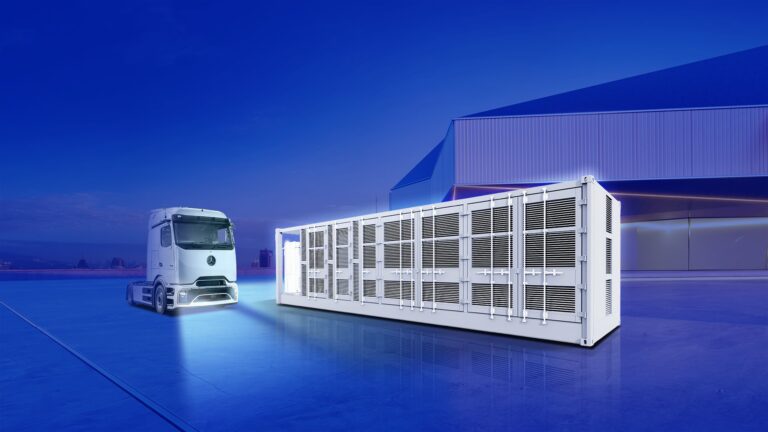
One approach that is increasingly proving its worth is the use of large mobile storage units with integrated fast-charging infrastructure, such as the eMobility Powerbank from Fleetboost. It enables charging capacities of up to 800 kW, even at locations with significantly lower connection capacities.
What is the eMobility Powerbank?
The eMobility Powerbank is a mobile energy storage device that temporarily stores electrical energy and provides fast charging power when needed.
The system is connected to the existing power grid, continuously charges energy into the internal storage, and releases it at high power when needed.
The result is a fast-charging infrastructure that is decoupled from the grid and can be used flexibly: for example, on leased premises, in temporary logistics centers, or during the gradual expansion of the fleet.
Technical features
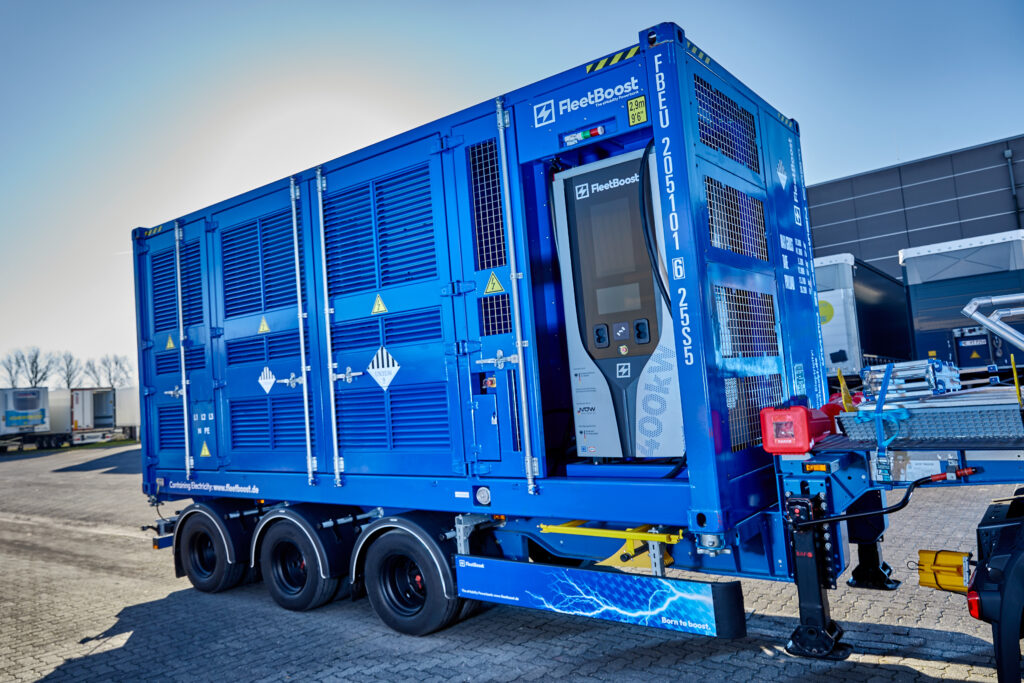
- Storage capacity: up to 2.13 MWh
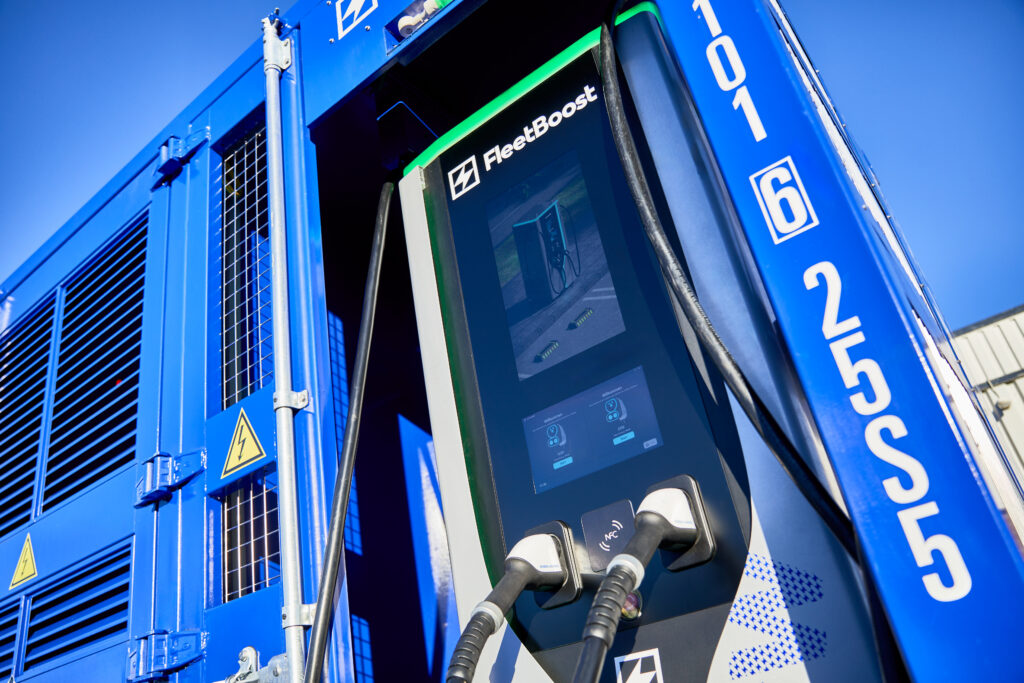
- Charging capacity: up to 800 kW (two fast charging stations, each with 400 kW)
- Battery technology: long-lasting LFP cells
- Cooling: liquid-cooled for high continuous loads
- Certification: TÜV-tested, CE-compliant
- Service: Maintenance and monitoring concept for industrial use
The systems are designed for daily commercial use and are manufactured by FleetBoost in industrial series production.
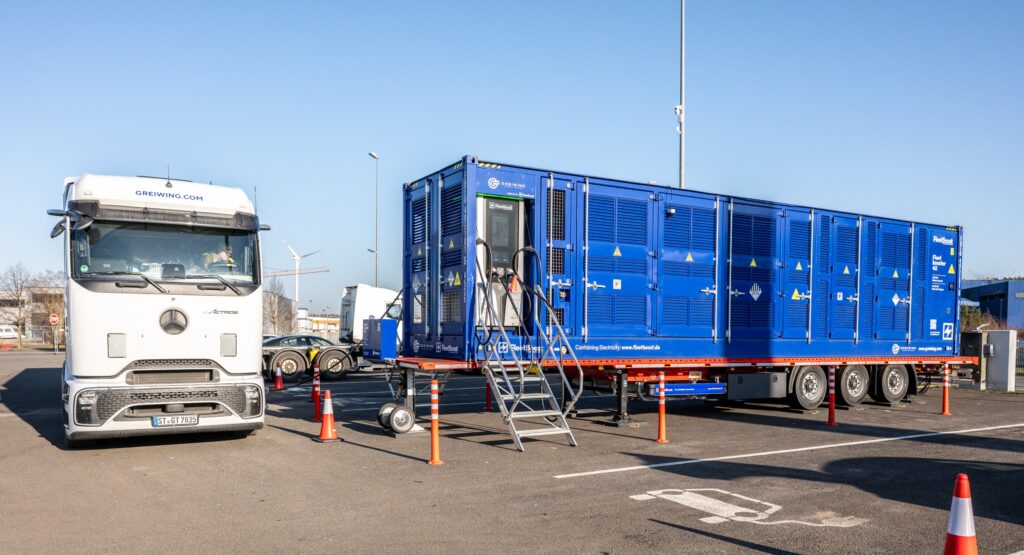
Practical example in Königs Wusterhausen – 800 kW charging capacity with a 100 kW grid connection
Key technical data:
- Grid connection: 100 kW
- Storage capacity: 2.13 MWh
- Provided charging power: up to 800 kW
- Two fast charging stations, each with a capacity of 400 kW
The power bank charges continuously via the existing grid connection and stores the energy internally. When electric trucks are charged, it releases the stored energy at high power. This means that several vehicles can be supplied in succession or in parallel, even in places where the grid connection would normally be too small.
Scalability as the key to electromobility
A single electric truck can be operated at almost any location. However, as soon as several vehicles need to be charged at the same time, the requirements for infrastructure, planning, and energy availability increase significantly.
Mobile storage solutions such as the eMobility Powerbank offer flexibility in this area. They enable charging infrastructure to be built up gradually, real operating data to be collected, and investments to be planned—without having to commit to a fixed structure at an early stage.
From start to integrated energy infrastructure
In the medium term, the logistics industry will establish its own depot charging infrastructure, ideally combined with its own power generation, for example through photovoltaics.
Mobile storage devices such as the eMobility Powerbank can be seamlessly integrated:
- as buffer storage to smooth out peak loads,
- as a temporary solution for new locations,
- or as an extension of existing charging points for a growing fleet.
This means that they are not just a transitional technology, but an integral part of future energy concepts.
Conclusion
The eMobility Powerbank from FleetBoost demonstrates how charging infrastructure in logistics can be designed to be flexible, scalable, and practical.
It allows you to start with existing grid connections and gradually expand charging capacity—up to high-performance operation with up to 800 kW.
It thus offers a realistic solution for companies that want to electrify their fleets without having to invest in rigid and cost-intensive infrastructure from the outset.